



Why WhatsApp is so popular in sales – and where the problem begins
There is hardly any other communication channel that is as intuitive, direct and ubiquitous as WhatsApp. In Germany, over 80% of the population uses the messenger – and its penetration is also impressive when compared to other European countries. So it’s no surprise that sales staff also like to use this channel: customers respond more quickly, messages land directly on the lock screen, and the feeling of a ‘direct line’ strengthens the customer relationship.
In reality, it looks like this: a sales employee quickly writes to a potential customer via WhatsApp to follow up on an offer or appointment. The customer responds immediately. Deal done. Efficient, uncomplicated – seemingly perfect.
But this is exactly where the problem begins.
Most organisations allow or tolerate the use of private WhatsApp accounts for such purposes – often without clear guidelines, without data protection checks and without awareness of the associated risks. The downside: as soon as an employee uses their private WhatsApp to communicate with customers, the organisation is on thin ice when it comes to GDPR.
What at first glance appears to be a pragmatic shortcut in the sales process can quickly turn into a legal nightmare – with fines, damage to reputation and loss of customer trust.
And the best part? The risks are completely avoidable – if you know the pitfalls and act early. In the next section, we’ll take a look at the first – and probably most dangerous – data protection mistake that many sales teams unknowingly make.
Table of contents
Mistake 1: Using your personal WhatsApp account for work
Probably the most common – and at the same time most dangerous – mistake in everyday sales is using private WhatsApp accounts for business communication. Many employees think, ‘I’ll just quickly write to the customer from my mobile phone.’ However, what is completely overlooked here is that the private version of WhatsApp is not intended for business use – and, above all, is not GDPR-compliant.
Why?
As soon as WhatsApp is installed, the app requests access to the entire address book. This means that all contacts – including private ones – are synchronised with WhatsApp’s servers. In the process, personal data (e.g. telephone numbers) is processed without the express consent of the persons concerned. This is a clear violation of the General Data Protection Regulation.
But there’s more:
The organisation also has no control over the communication history, files and media sent via private accounts. This means: No archiving, no access in the event of disputes, no possibility of controlling the content.
The consequences?
- Fines: Data protection authorities are becoming increasingly sensitive to this type of use.
- Reputational damage: Customers quickly lose trust when they learn that their data is being handled via private devices.
- Legal grey areas: Especially in the B2B sector, this can quickly lead to contractual problems.
What’s more, even if a device is lost or an employee leaves the organisation, contact details, chat histories and, in some cases, sensitive information are beyond the organisation’s control – a nightmare for any compliance department.
The solution? Clear separation of professional and private communication – and the use of professional, GDPR-compliant tools. But more on that later.
In the next section, we’ll first take a look at the second critical mistake: the handling of consent and lack of transparency.

Mistake 2: Lack of consent and transparency regarding customer data
Speed is essential in sales – that is undisputed. However, when things need to be done quickly, one thing often falls by the wayside: legally compliant consent for data processing. And this is precisely where the second major data protection mistake lurks.
Many salespeople (or customers) simply write to customers (or salespeople) via WhatsApp – because the number was taken from the CRM, comes from a business card or ‘there has already been contact before’. Sounds harmless? It isn’t.
Because:
The GDPR requires clear, informed and voluntary consent before personal data may be processed or stored – including before contacting a customer via Messenger. It is not sufficient if the number is stored somewhere or if the contact once agreed to be contacted by email. WhatsApp is an independent communication channel – and requires separate consent. Above all, such consent must be documented in a sustainable manner. This is virtually impossible with private WhatsApp.
It becomes particularly critical when content such as offers, contract documents or personal information is sent unsolicited. This can quickly give the impression that an organisation is handling data negligently – an absolute no-go, not only from a legal perspective, but also from the point of view of customer loyalty.
Typical consequences:
- Warnings from competitors or data protection officers
- Loss of leads due to unsettled contacts
- Fines for violations of information obligations and consent documentation
The second mistake is therefore not only a legal issue, but also a risk to customer satisfaction. Anyone who is contacted via WhatsApp expects – especially in a professional context – that their data will be processed securely, traceably and transparently.
And that only works if the sales team works with a legally compliant system that automates and documents. We’ll show you what that might look like later on – but first, let’s take a look at mistake number 3: WhatsApp vs. WhatsApp Business App.
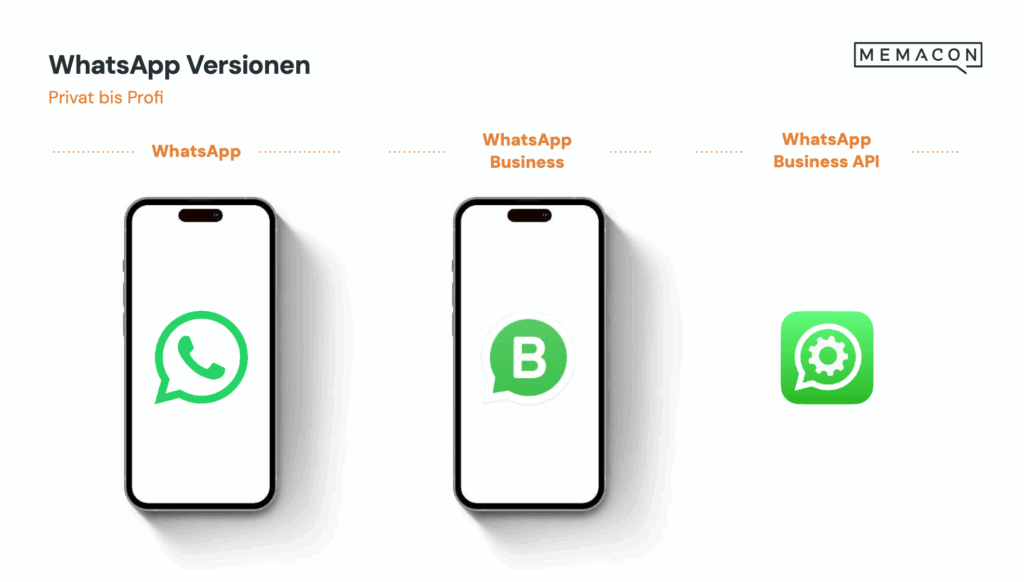
Mistake 3: The WhatsApp Business app is not automatically GDPR compliant
A common misconception:
‘If we use the WhatsApp Business app, everything is secure.’
Unfortunately, this is not true – and this is the third critical mistake that many organisations and sales teams make.
Although the WhatsApp Business app differs functionally from the private version – e.g. through automatic replies, company profiles or quick replies – it technically runs on the same infrastructure as the private app. And this is precisely where the problem lies:
Both versions – private and business – store and process data on US servers.
In concrete terms, this means:
- No EU hosting, no GDPR-compliant data storage
- Address book access still required
- No control over the transfer of personal data to third parties (Meta/WhatsApp)
Even though the WhatsApp Business app sounds ‘business-like’, it does not change the legal framework.
Only with the WhatsApp Business API is it possible to operate WhatsApp in Germany or the EU in a GDPR-compliant manner – even in sales.
Only through this specially created interface is it possible to:
- Obtain and document consent in a legally compliant manner
- Store data in a controlled and encrypted manner
- Handle messenger communication via certified partners and GDPR-compliant systems
Organisations that really want to play it safe must therefore think beyond the app level – and rely on an API-based solution such as that offered by Memacon with its strong professional software partners.
So avoid the illusion of security – and rely on genuine legal clarity.
Addendum – Mistake 4: No clear guidelines or training for the sales team
Many data protection problems arise not from malicious intent, but from ignorance. And that is precisely the third major mistake: organisations leave the use of WhatsApp in sales to chance. There are no clear rules, no training and often not even a conscious decision as to whether and how WhatsApp may be used at all.
The result?
Every employee communicates differently. Some use their private account, others install WhatsApp Business, and still others just start writing – and no one knows exactly what is allowed and what is not. There is a lack of:
- Binding usage guidelines for messengers in sales
- Data protection training on the use of WhatsApp
- A defined communication strategy that combines legal certainty and efficiency
In small and medium-sized organisations in particular, this often happens “in practice”. People start using WhatsApp because it works – but without control over the process. And that is highly risky: even a single violation by a well-meaning but untrained sales colleague can have legal consequences for the entire organisation.
Particularly sensitive:
- Chat histories with sensitive data end up on private devices
- There is no central backup strategy
- Content is not formulated in a consistent or professional manner
A lack of training is therefore not only a data protection problem – it is also an image problem. Because customers notice whether they are dealing with a professional process or not.
The good news is that there are solutions that can help you get your team up to speed, organise them and protect them legally at the same time – without having to forego the advantages of WhatsApp.
In the next section, I will show you exactly these alternatives.
Using WhatsApp in sales in compliance with data protection regulations – these solutions are available
Want to use WhatsApp in sales – but legally, securely and professionally? Then there’s no way around a properly set up system.
And that’s exactly what we offer at Memacon: data protection-compliant WhatsApp communication that remains just as easy for your customers as before – but is finally secure and controllable for you as an organisation.
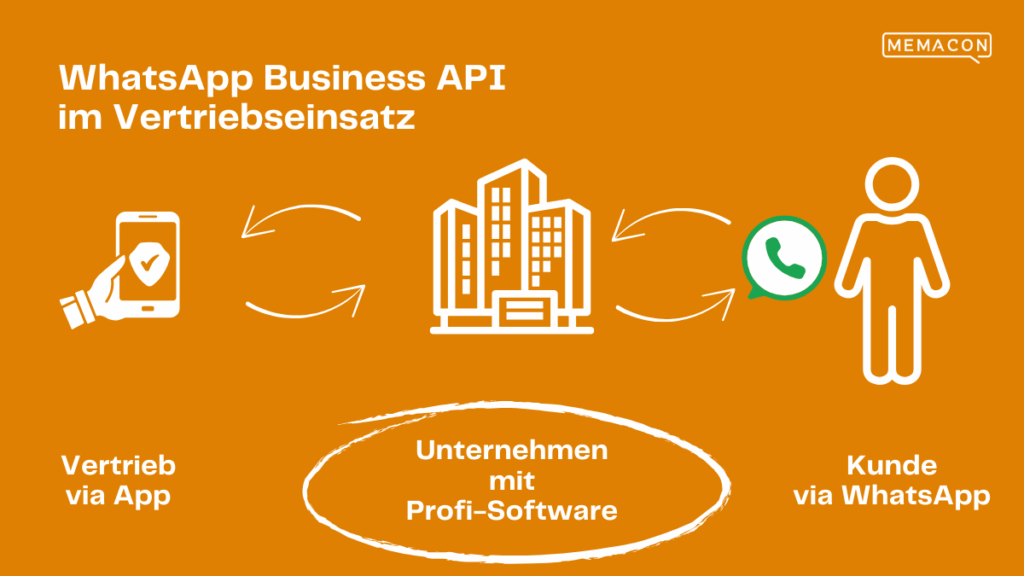
What is the basis for this? A certified business solution – with an app for sales staff
We work exclusively with technology partners who have a web interface AND a mobile app for employees.
What does that mean specifically?
- Your sales team installs a special app on their smartphones (e.g. iOS or Android)
- This app uses the official WhatsApp Business API – not the private version
- Customer data is no longer stored locally in the address book
- All chats run over a secure connection, are centrally managed and can be archived
- Hosting and data processing are GDPR-compliant in Germany or the EU.
Important: Nothing changes for the end customer!
They chat as usual via WhatsApp – but in future with a new, official phone number controlled by your organisation. No new app, no new behaviour. Just secure, professional and legally compliant.
Additional professional WhatsApp solutions for organisations
In addition to the data protection-compliant use of WhatsApp in sales, Memacon offers a range of specialised professional solutions that help organisations take communication, recruiting, events and training to a new level – securely, efficiently and entirely via WhatsApp.
Memacon WhatsBiz™
GDPR-compliant WhatsApp marketing & sales communication
The ideal solution for B2B or consultation-intensive sales:
- Personalised WhatsApp marketing with extremely high open rates
- Direct communication by sales staff via web app or mobile app
- Integration into existing systems such as CRM or ERP
- Interactive content, newsletters, self-service & live chat included
👉 Perfect if you need fast sales cycles, high reach and legal security.
Memacon WhatsExpo™
Secure leads and contacts directly at the exhibition
Data protection also applies to sales at events and exhibitions.
With WhatsExpo, you can collect leads directly via WhatsApp – automatically, in multiple languages and in compliance with GDPR:
- Visitors simply scan a QR code
- The exhibition bot starts immediately via WhatsApp
- All data is stored centrally and transmitted in a legally compliant manner
- Consultation appointments, brochures, competitions: everything directly via chat
👉 Customer communication starts immediately – and remains active even after the exhibition.
Memacon WhatsAI-Trainer™
Sales training directly on your smartphone
Your team needs to know how to use WhatsApp properly – and what not to do.
With WhatsAI-Trainer, you can train your sales team right where they already are: on their mobile phones, via WhatsApp.
- Data protection fitness, objection handling, product knowledge
- Interactive quizzes, learning nuggets and challenges
- No LMS, no new app – just WhatsApp
👉 Ideal for onboarding new employees or continuous training.
You don’t have to do without WhatsApp in sales – you just have to do it right.
With Memacon, you get a GDPR-compliant infrastructure, trained teams and proven tools that have proven themselves in practice.
Modern sales need secure tools – no grey areas
WhatsApp has become an integral part of today’s communication – including in sales. But what many people underestimate is that the seemingly easy route via the private app can quickly become a legal own goal. Data protection violations, lack of consent and unclear guidelines are no trivial matter – they jeopardise trust, customer data and, in the worst case, the success of the company.
But the good news is: there are now secure alternatives.
With solutions from Memacon – e.g. WhatsBiz™, WhatsAI-Trainer™ and WhatsExpo™ – you can continue to use WhatsApp efficiently for your sales activities without violating the GDPR. Your team works via a certified app that is directly connected to the WhatsApp Business API. For your customers, everything remains the same: they write as usual via WhatsApp – just to a new, secure number.
This allows you to combine the best of both worlds:
- The proximity and speed of WhatsApp
- The security, control and scalability of a professional sales infrastructure
So: no more workarounds and risks.
Focus on responsible handling of customer data – and take your sales to a new level. If you like, we would be happy to show you how this could work in your organisation.