



Five reasons why WhatsApp channels are not compliant with data protection regulations!
Imagine reaching your target audience with just one click directly on their smartphone – no email, no advertising, no detours. That’s exactly what WhatsApp channels promise, the relatively new feature from Meta that allows companies, influencers and organisations to distribute content directly via WhatsApp. Fast, wide-reaching and familiar. Sounds too good to be true?
The downside: data protection.
Because while WhatsApp Channels impress every marketer, they cast a long shadow legally. More and more companies want to use the channels in their customer communications – without really being aware of the data protection risks.
Are WhatsApp Channels really GDPR-compliant?
This is a question currently being asked by many data protection officers, IT departments and managing directors. And the answer – at least as things stand at present – is quite clear: No.
In this article, we’ll show you 5 specific reasons why the use of WhatsApp Channels is problematic from a data protection perspective. You will learn about the risks involved, why companies currently have no clear legal basis for using them, and what consequences this could have in the worst case scenario.
If data protection is important to you – for your company, your customers and your compliance – you should read on. Because WhatsApp Channels could cost more than they bring in.
Table of contents
What are WhatsApp Channels?
WhatsApp Channels are a relatively new format within the WhatsApp Business app that companies, organisations and creators can use to send one-way content to an unlimited number of subscribers – similar to Telegram channels or a newsletter feed. Users can follow a channel, view posts and react with emojis, but cannot reply or interact directly.
What many people overlook is that
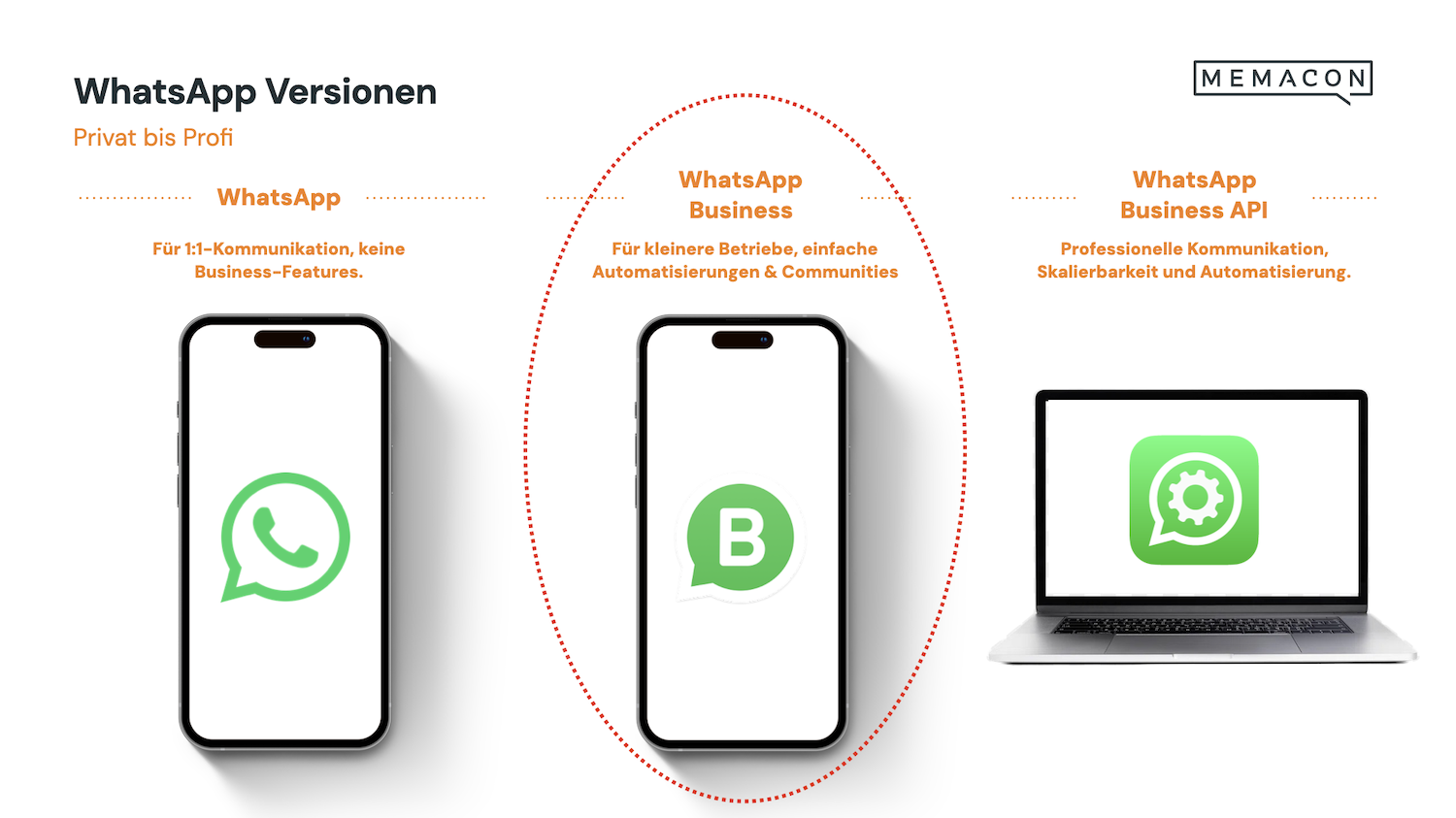
WhatsApp Channels are not a standalone product, but an integral part of the WhatsApp Business app – and it is precisely this app that has been criticised for years for serious data protection issues. The Business app does not offer secure data processing, a data processing agreement (DPA) that complies with GDPR requirements, or complete transparency on how personal data is used.
Reason 1: Processing of personal metadata
At first glance, WhatsApp channels appear to be purely broadcast channels – no replies, no direct conversations, just information. But even without direct dialogue, WhatsApp collects a wealth of personal metadata in the background, and this is precisely where the data protection problem begins.
What many people don’t know is that even if no content is stored, metadata such as time of use, device type, IP address, location data or user behaviour (e.g. when someone opens a post or reacts with an emoji) can be clearly attributed to a person. According to the GDPR, this data is considered personal and is therefore subject to strict rules.
Particularly critical: users are not informed transparently about which of this metadata is collected and how it is further processed. Companies that use WhatsApp Channels therefore cannot ensure that data processing complies with the GDPR. And this is precisely a violation of Articles 5 and 6 of the GDPR, which regulate purpose limitation, data minimisation and the lawfulness of processing.
Even if a company believes that it does not store any personal data, it is jointly responsible under the GDPR if the service used (in this case WhatsApp/Meta) collects and processes data in an unauthorised manner.
A simple example:
When a user follows a company WhatsApp channel, WhatsApp/META can draw conclusions about their interests or professional activities – e.g. if they follow a WhatsApp channel for a clinic, a political association or an HR platform. This alone can be considered sensitive information.
Metadata is not harmless data residue – it is part of your digital fingerprint! And with WhatsApp channels, this fingerprint is anything but secure in terms of data protection.
Reason 2: Data transfer and storage on international servers
One of the most central criticisms of WhatsApp Channels is the transfer of data to third countries, especially the USA. Why is this so problematic? Because the GDPR imposes strict requirements when personal data leaves the EU. And this is precisely where the WhatsApp Business app regularly fails – and demonstrably so.
Meta (the parent company of WhatsApp) processes a lot of data on servers outside the EU. Although the new EU-US Data Privacy Framework was introduced in July 2023, it does not replace the requirements for a GDPR-compliant data processing agreement (DPA) or standard contractual clauses when using services such as WhatsApp Business or WhatsApp Channels. And it is precisely these documents that do not exist in a form that the GDPR requires – neither for WhatsApp Business nor for WhatsApp Channels.
This means that companies using WhatsApp Channels pass on their users’ personal data (e.g. through metadata, logins, reactions or interactions) to a US company without having a legally sound basis for doing so. This is a clear violation of Articles 44 ff. of the GDPR, which regulate data transfers to third countries.
Even more controversial: Meta is obliged by the Cloud Act (USA) to grant US authorities access to stored data upon request – even if this data is stored in the EU. Companies therefore not only lose control over the data, but also risk unwittingly participating in surveillance measures.
A practical example:
If a German SME operates a WhatsApp channel for its products, the behavioural data of subscribers could end up on US servers – without users knowing or consenting to this. This is a clear violation of the GDPR’s transparency requirement.
As soon as data is stored or processed outside the EU, it becomes a sensitive issue – without the necessary legal basis, companies enter a legal grey area with enormous risk.

Reason 3: Lack of transparency and control
A key principle of the GDPR is transparency!
Users have the right to know what data is collected, how it is processed and where it is shared. This is precisely where WhatsApp channels fundamentally fail – both from the perspective of users and businesses.
When a company publishes content via a WhatsApp channel, it creates the impression of simple, one-way communication. However, running in the background is a highly complex data system that is not transparent to those involved.
Neither companies nor subscribers receive a complete overview of:
- what data WhatsApp/Meta actually collects,
- how long it is stored,
- for what purpose it is used,
- and to whom it may be forwarded.
The problem: WhatsApp does not offer any option for individual data control, as required by the GDPR (e.g. data copy, information, deletion in accordance with Articles 15–17 GDPR). Companies that operate channels cannot fulfil these transparency obligations – even though, according to the GDPR, they would be jointly responsible with Meta.
This is particularly critical for use in the B2B or healthcare sectors. When customer data with potentially sensitive information is involved, a situation can quickly arise in which consent cannot be obtained correctly and processing procedures cannot be clearly documented – a risk for fines and reputational damage.
As long as WhatsApp does not provide a transparent, auditable overview of its data processing, WhatsApp channels systematically violate key principles of the GDPR.

Reason 4: No clean DPA contract possible with WhatsApp
Companies are required to conclude a data processing agreement (DPA) with every service provider that processes personal data on their behalf. This is not just some fine print – it is a clear requirement of the GDPR under Article 28.
With the WhatsApp Business app – especially in the context of WhatsApp channels – such a contract is not fully possible.
The main objections to the DPA integrated into the Terms & Conditions are:
- Address book synchronisation and third-country transfer
- WhatsApp Business continues to access the device’s entire address book and transfers the contacts – even those who never wanted to use WhatsApp – to the USA or to Meta servers.
- Processing of metadata
- While message content is end-to-end encrypted, metadata (who, when, from where, how often, with whom) is processed openly and on a large scale by WhatsApp. This data is not protected and can be used for profiling or marketing purposes, which is particularly critical for professionals bound by professional secrecy (e.g. doctors, solicitors).
- Incomplete or weak DPA
- According to critics and data protection experts, the DPA (Data Processing Terms) referenced in the Terms does not fully meet all the requirements of Art. 28 GDPR – in particular, there are no precise regulations on binding instructions, control rights, dealing with sub-processors and the return versus deletion of data after the end of the contract.
- Insufficient control and deletion options
- WhatsApp does not offer any legally binding mechanisms that companies can use to prove that data has actually been completely deleted at the request of the persons concerned.
- Transparency and duty to inform
- Companies are obliged to inform customers explicitly and in advance about how WhatsApp handles their data. These requirements are difficult to implement in practice, as WhatsApp itself offers only limited transparency and often provides user information in English or in a form that is difficult to understand.
Meta does not offer an AVV contract for WhatsApp Channels that complies with GDPR requirements. Period. Companies that use this service thus pass on personal data to an external provider without the necessary legal protection.
What does this mean for companies?
According to the GDPR, anyone who uses WhatsApp channels in a business context assumes joint responsibility – but has no contractual basis to prove the security and legality of data processing. In serious cases, this can result in heavy fines or even injunctions from data protection authorities or consumer protection agencies.
Many companies already operate a WhatsApp channel with thousands of subscribers…how do companies respond when a user requests information about their stored data? How do they intend to implement this basic principle of the GDPR if they have no insight and no solid DPA agreement with WhatsApp/META?

Reason 5: Lack of consent and opt-in mechanisms
The GDPR requires clear, voluntary and informed consent for any processing of personal data – especially in a marketing context. Simply following a channel is not sufficient. It must be clearly documented and revocable at any time that the user has understood what data is being collected, for what purpose and by whom.
And this is where the next major data protection problem with WhatsApp Channels becomes apparent:
There is no clean, documented opt-in process.
When a user joins a WhatsApp Channel, this happens within the WhatsApp app – without any reference to data protection guidelines, without a checkbox, without actively consenting to specific data processing. Companies also have no way of customising or extending this process. The result: the transparency and traceability required by law are lacking.
Furthermore, companies cannot prove when and how a user has given their consent – which is mandatory under the GDPR. This means that not only is there no legal basis for many forms of communication via the channel, but also no possibility of arguing legally in the event of a dispute (e.g. in the case of complaints or warnings).
Particularly critical:
If personalised content or conclusions about users’ interests are possible via the WhatsApp channel (e.g. through reactions to posts), this is no longer simply information, but personalised profiling – without consent.

Bonus reason: No real added value – just branding but no real marketing power!
At first glance, WhatsApp channels may seem like a simple tool for modern communication – but if you take a closer look, you’ll quickly realise that they don’t deliver any real added value for businesses. On the contrary: they are a digital one-way channel with no depth, no interaction – and no strategic benefit.
Compared to professional WhatsApp marketing solutions (e.g. via the WhatsApp Business API), WhatsApp channels lack almost all the features that modern marketing needs today:
❌ No GDPR-compliant data collection:
While the WhatsApp newsletter, for example, allows interests to be automatically queried and neatly documented via chat, no segmentation is possible with channels.
❌ No campaign control:
There are no filters, no targeting, no A/B testing – and no meaningful analytics for measuring success.
❌ No personalisation:
You can’t write ‘Hello Max’ or refer to previous interactions – everything is anonymous, impersonal and interchangeable.
❌ No real format freedom:
Only 16:9 posts with text, images or video – no buttons, no forms, no quiz logic, no automated chat flows.
❌ No real inbound campaigns:
In a real WhatsApp newsletter, you can trigger interaction, share tips, offer advice or even map entire funnels. Channels? They can’t do any of that.
❌ No creativity:
While professional WhatsApp marketing allows for dynamic journeys, links, product suggestions, surveys and more, Channels only allows you to post and hope for the best.
The irony?
Real WhatsApp newsletter solutions with all these options are available from as little as £15 per month.
GDPR-compliant, flexible, measurable – and above all: effective.
If you want to communicate professionally with WhatsApp as a business, you need real tools – not half-baked solutions like WhatsApp Channels. Because data protection without functionality is already critical. But no functionality and no clean data protection? Doesn’t that sound like a pure waste of resources?
Conclusion and outlook
WhatsApp channels may seem attractive at first glance – fast, uncomplicated and directly accessible. But on closer inspection, one thing becomes clear: from a data protection perspective, they are a risk – and from a marketing perspective, a missed opportunity.
The five key GDPR violations speak for themselves:
- metadata processing without control,
- data transfer to unsafe third countries,
- lack of transparency for users,
- no data processing agreement,
- and no legally compliant consent.
Added to this is the bonus reason, which weighs even more heavily: WhatsApp channels do not bring any functional added value for companies. No segmentation, no personalisation, no automation, no measurable results. It remains a broadcast channel in beta stage – with no prospects for professional communication or sustainable inbound marketing.
Anyone relying on messenger communication today should opt for the WhatsApp Business API, which is truly GDPR-compliant and powerful at the same time. WhatsApp newsletters based on the Business API offer exactly that – starting at just £15 per month. They enable personalised dialogues, meaningful segmentation, creative campaign management and transparent performance monitoring. And all this on a channel that over 90% of Europeans actively use.
Our recommendation:
Before you decide on WhatsApp channels, carefully check the legal and technical framework conditions. And if you want to build customer relationships that really last, rely on proven, legally compliant tools – with real added value for you and your target group.
Want to know how you can use WhatsApp in marketing in a way that complies with data protection regulations and creates an outstanding customer experience?
Note: The information provided on this website does not constitute legal advice and is not intended to address any legal issues or problems that may arise in individual cases. The information on this website is of a general nature and is provided for informational purposes only. If you require legal advice for your individual situation, you should seek the advice of a qualified solicitor.